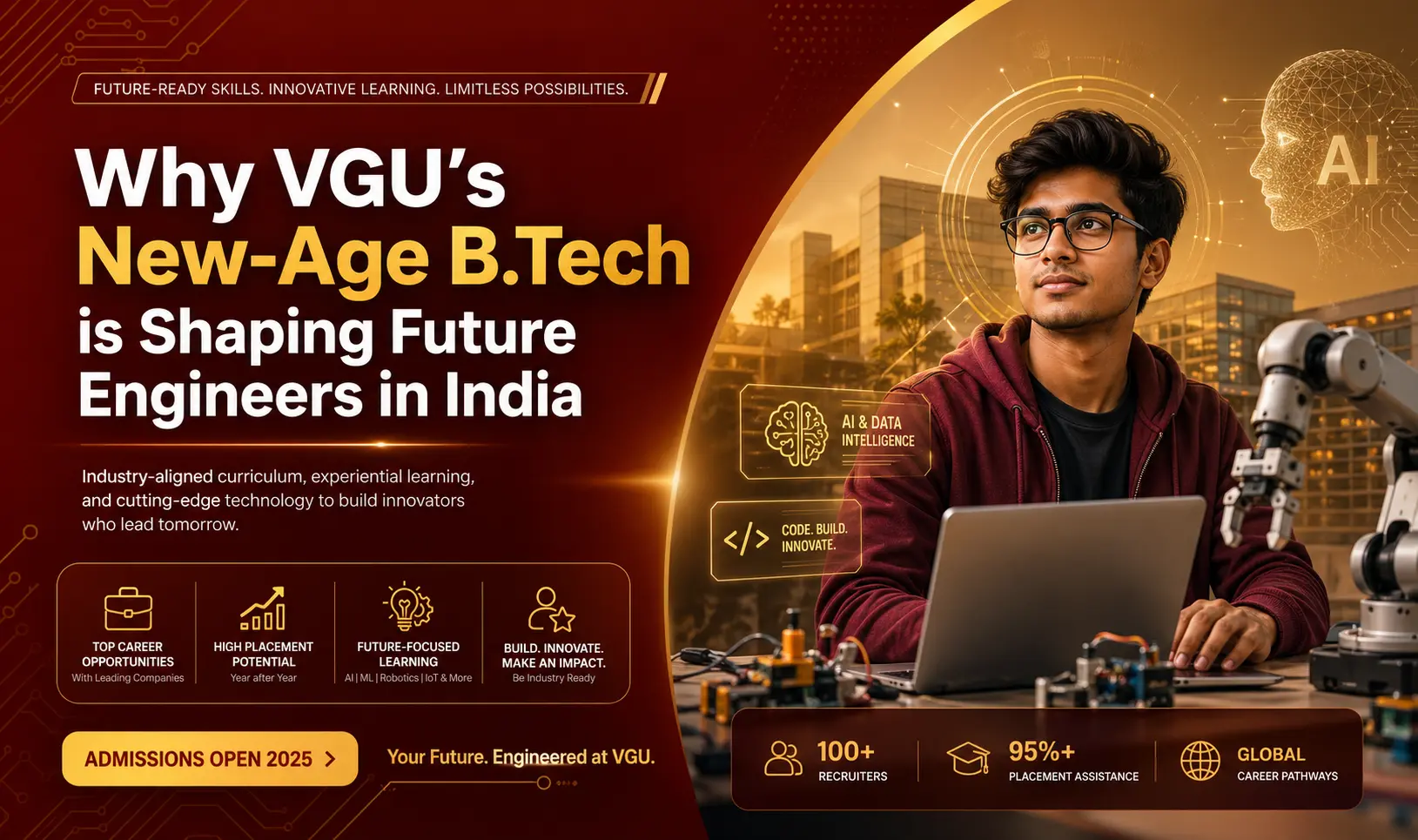
Vivekananda Global University (VGU), Jaipur is positioning its B.Tech offering as a future-facing engineering ecosystem built around emerging technologies, innovation-led learning, transdisciplinary exposure, and strong industry integration. Rather than treating engineering education as a narrow branch-based degree, VGU presents its B.Tech programs as a platform where students build technical depth in AI, data science, cyber security, cloud, IoT, robotics, and full stack development while also gaining exposure to entrepreneurship, research, internships, and global certifications.
Engineering for the new technology era
At the core of VGU's new-age B.Tech identity is its focus on technologies that are actively reshaping industry. The university's engineering ecosystem highlights specializations and pathways in Artificial Intelligence, Data Science & Machine Learning, Cyber Security, Cloud Computing, Internet of Things, Robotics, and Full Stack Development, aligning academic choices with high-growth digital careers. This is important because today's engineering graduates are expected not only to understand programming fundamentals, but also to work with intelligent systems, data-driven decision-making, automation, secure digital infrastructure, and scalable platforms.
This future-tech orientation gives VGU's B.Tech programs a distinct contemporary identity. Students are not prepared merely for conventional job titles; they are introduced to the skills ecosystem behind AI-powered applications, digital transformation, analytics, secure computing environments, and software product development. In that sense, the university's B.Tech model speaks directly to the expectations of the digital economy and the changing hiring landscape.
Transdisciplinary learning beyond silos
A major feature that strengthens VGU's positioning is its emphasis on transdisciplinary learning. Through the university's research and innovation framework, students are encouraged to engage in structured transdisciplinary projects that move beyond traditional academic silos and connect engineering with management, design, law, healthcare, agriculture, and other fields. This approach reflects the reality of modern problem-solving, where industry challenges rarely belong to one discipline alone.
For B.Tech students, this means learning to define a problem, investigate it from multiple lenses, build a solution, prototype it, validate it, and understand its real-world impact.Such project exposure develops not only technical competence but also systems thinking, collaboration, communication, and solution design capability. These are precisely the attributes that distinguish a new-age engineer from a conventional degree holder.
Innovation-led campus culture
VGU's B.Tech story also stands out because innovation is built into the institutional ecosystem rather than treated as an extracurricular activity. The Institution's Innovation Council (IIC-VGU) describes innovation as a campus culture and positions students as future entrepreneurs, job creators, and problem-solvers supported by mentorship, infrastructure, and policy backing .This matters for engineering education because many of the most valuable outcomes today emerge when technical ideas are tested as products, prototypes, startups, and scalable solutions.
The university's innovation system is strengthened further by dedicated incubation and startup support structures. VGU-TBI supports technology-based startup development, while the wider ecosystem creates pathways from ideation to incubation and commercialization. For B.Tech students, this creates an environment where classroom ideas can evolve into prototypes, IPR assets, research outputs, and startup ventures.
ACIC-VGU Foundation and entrepreneurial acceleration
One of the strongest additions to VGU's new-age B.Tech narrative is the ACIC-VGU Foundation, established under the Atal Innovation Mission, NITI Aayog. VGU describes it as India's first Atal Community Innovation Centre in a private university and positions it as a major platform for incubation, deep-tech support, grassroots innovation, mentorship, and startup growth in Tier-2 and Tier-3 regions. According to the university, the foundation has incubated more than 140 startups, impacted over 15,000 aspiring entrepreneurs, built 60+ partnerships, onboarded 50+ mentors, conducted 200+ events, and operates with six prototyping labs and structured support mechanisms.
This ecosystem is highly relevant to B.Tech students because it connects engineering education to innovation implementation. Students working on AI tools, cyber security ideas, analytics products, hardware solutions, sustainability applications, or social-impact technologies can potentially move from project work to incubation support within the same university environment. The foundation also reports access to government-backed schemes and more than ₹16 crore in grants support, which strengthens the case for VGU as an innovation-led engineering campus rather than a conventional teaching-only institution
Mandatory internships and industry immersion
Another defining new-age element is VGU's emphasis on practical exposure through internships, training, and industry engagement. The university's training and industry connect framework highlights certification support, employer engagement, live interaction with industry professionals, and internship-oriented grooming that prepares students for workplace expectations before graduation. This aligns with the needs of modern engineering education, where employability is shaped by practice, communication, teamwork, tools exposure, and execution ability as much as by classroom performance.
In narrative terms, a mandatory internship model strengthens the credibility of a B.Tech program because it ensures students engage with real work environments, business problems, tools, teams, and timelines. It also makes project learning more meaningful, since students can connect academic concepts with practical implementation in software, analytics, security, automation, and product environments.
Coursera, LinkedIn Learning and global certifications
A new-age B.Tech program must also recognize that not all valuable learning happens only inside the classroom. VGU has invested in personalized and globally aligned learning pathways through platforms such as Coursera and LinkedIn Learning, alongside certification opportunities from major industry and learning partners. This gives students access to career-relevant content, micro-credentials, and professional learning tracks that complement the degree curriculum
For engineering students, this is especially significant in fast-evolving domains such as AI, data science, cloud technologies, cyber security, and product development, where technology stacks evolve faster than traditional university update cycles. By combining formal academics with global learning platforms, VGU signals that its B.Tech programs are designed for continuous skill-building rather than static syllabus completion.
Research, patents and paper publication culture
What truly elevates a B.Tech program into a new-age category is its connection to research and intellectual property creation. VGU's research ecosystem highlights a strong emphasis on patents, copyrights, paper publication, and commercialization-oriented inquiry. The university's Research and Development Cell states that ACIC, TBI, IIC, and IIIC work together to drive research commercialization and startup creation, showing that innovation and research are institutionally interconnected.
The same research profile reports a substantial patent pipeline, including 500+ patents applied and a total patent count running into the hundreds, along with 20+ copyrights. Other university-linked material highlights 370 patents published and granted, 250 patents applied, and 2,622 Scopus, SCI, and WoS publications, alongside multidisciplinary faculty supervision and cross-disciplinary integration. The university's industry-connect page also highlights 370+ patents published and granted and 500+ research papers published.
For B.Tech students, this research culture matters enormously. It creates an academic environment where final-year projects, transdisciplinary problem statements, prototype development, and innovation challenges can lead to paper publication, patent filing, copyright creation, and even commercialization opportunities. In practical terms, this transforms project work from a classroom requirement into a professional portfolio asset.
New pedagogy and high student engagement
VGU's B.Tech positioning also reflects a shift in pedagogy from passive teaching to active, project-driven engagement. Related technology programs at the university explicitly emphasize project-based learning, live assignments, hands-on exposure, and continuous engagement with applied tools and practical outputs. This is the kind of pedagogy that suits future-tech education, because students understand AI, analytics, software systems, and cyber security best when they build, test, debug, present, and improve solutions.
Student engagement in this context goes beyond clubs or classroom attendance. It includes ideathons, innovation events, startup bootcamps, certification journeys, lab work, internships, prototype building, mentoring, publication opportunities, and exposure to incubation systems.[cite:8][cite:16] This creates a vibrant learning environment where engineering students participate actively in their own growth and career shaping.
A compelling new-age B.Tech proposition
Taken together, these elements make VGU Jaipur's B.Tech proposition significantly more contemporary than a traditional engineering degree model.[cite:1][cite:3][cite:5] AI, data science, cyber security and other future-tech domains provide technical relevance; transdisciplinary projects provide broader problem-solving ability; internships and industry connect build employability; Coursera and LinkedIn Learning add global exposure; and ACIC, patents, startup incubation, research papers, and publication culture add innovation depth.
For students and parents evaluating engineering education in 2026, the message is clear: VGU's B.Tech is being shaped as a new-age, new-tech, innovation-led program designed for future skills, active engagement, research orientation, and real-world readiness. It is not just about earning a degree in engineering; it is about becoming a builder, innovator, researcher, and professional who can thrive in the next era of technology.


