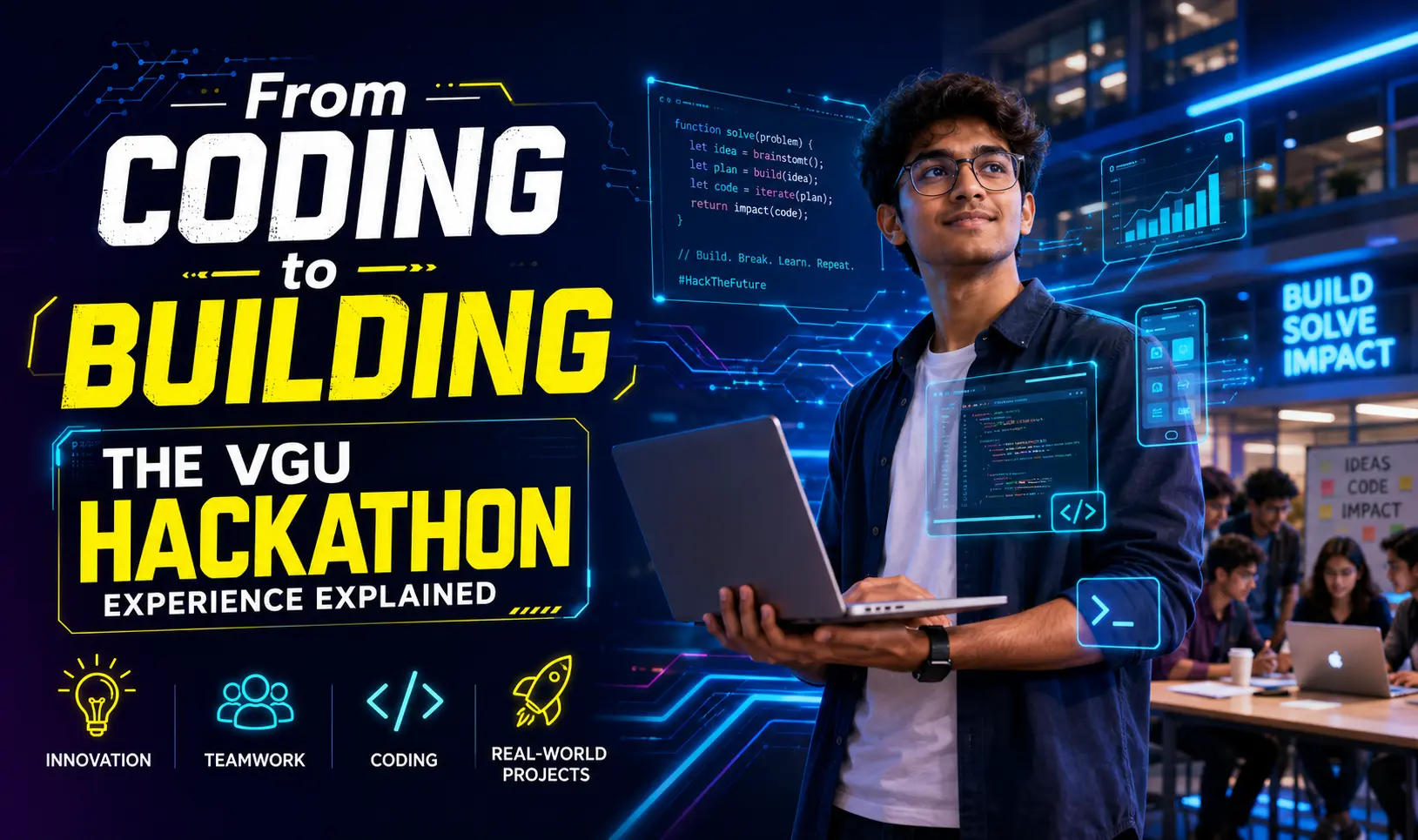
The Night I Stopped Being Just a Student
I remember sitting cross-legged on the floor of the VGU labs at 3 in the morning. My laptop screen was the brightest thing in the room. Red Bull cans were scattered across the table like trophies of something we hadn't yet earned. My teammate Arjun was debugging a Python API that had been refusing to talk to our frontend for the past six hours. Someone in the corner was stress-eating Parle-G biscuits. And I — I was staring at a blank function block, completely unsure if what we were building was genius or garbage.
This was Code Red, ACIC-VGU Foundation's 72-hour non-stop hackathon. And in that single sleep-deprived, adrenaline-charged moment, I understood something my classrooms had never been able to teach me — what it actually feels like to build something under real pressure.
If you are a B.Tech CSE or AI Engineering student at VGU and you have not experienced this culture yet, let me tell you what you are in for. And if you have already lived it — you know exactly what I am about to say.
"This was not just a hackathon. It was 72 hours of learning to be a builder, a communicator, a problem-solver — and most importantly, a version of myself I had never met before."
Code Red: The Event That Runs on Chaos and Coffee
Code Red is the flagship hackathon of ACIC-VGU Foundation — India's first functional ACIC supported by Atal Innovation Mission (AIM), NITI Aayog. What started as a bold 72-hour coding challenge in 2021 has grown into what is now called a Triathlon — a mega innovation event that combines a Hackathon, a Design-a-thon, and a Youth Ideathon, all running simultaneously on the VGU campus over three full days and nights.
The prize pool speaks for itself. Code Red 3.0 offered INR 7,50,000 to winners. Code Red 4.0 upped the ante with INR 5,00,000+ in prizes. But every student who has stood at the final presentation table will tell you — the prize was never the real reward.
The themes across editions have tracked exactly where the world is heading. In the very first edition in 2021, teams could choose from AI & Machine Learning, Agri-Tech, and Design & Craft. By Code Red 3.0, the challenge had sharpened: real-world problem statements demanding sustainable energy solutions and enhanced security technology. By Code Red 4.0 in October 2024, the themes were Sustainable Cities & Communities and AI for Societal Good — two domains that are at the absolute centre of what AI Engineering graduates need to understand.
Registration opens weeks before the event. Teams of two to four members sign up. On day one, you arrive on campus, you receive your problem statement — and the clock starts. That's it. Seventy-two hours. From idea to working prototype to final pitch.
"The clock shows 72:00:00. Your team has no idea what you'll build yet. Welcome to Code Red."
Hour Zero to Hour 72: What Those Three Days Actually Look Like
Hours 0–8: The Idea War
The opening hours feel electric. You unpack your laptop, find your team's spot in the lab or the open innovation zone, and you argue. Beautifully, productively argue. What problem are we solving? What tech stack do we use? Do we build an app, a model, a dashboard — or all three? In this phase, being a CSE or AI Engineering student at VGU gives you a specific kind of edge, because our coursework does not stay siloed. When you've worked on transdisciplinary projects — mixing engineering thinking with design and communication — you approach ideation differently. You think in systems, not just in code.
Hours 8–24: When the Real Work Begins (and Sleep Ends)
By evening, the room has transformed. The polite conversation is over. Everyone has their head down. The lab becomes a symphony of keyboard clicks, muffled frustrated groans, and the smell of Maggi from the canteen. Nobody goes back to the hostel. Sleeping on a lab chair for two hours and coming back to the screen is not unusual — it is a rite of passage. The lights in the VGU innovation zone do not dim. Day and night, students code, build, and solve with full dedication. That phrase "all-night culture" is not metaphorical. It is literal. It is beautiful. And it is absolutely terrifying the first time you live it.
This is also when the mentors start circulating. ACIC-VGU makes sure that industry mentors and faculty guides are available throughout. A senior walking by your station at midnight and saying "This approach has a scalability issue — have you considered this?" can completely reframe three hours of work. And somehow, instead of feeling demoralizing, it feels like rocket fuel.
Hours 24–48: The Valley of Doubt
This is the phase nobody talks about enough. Around the 28-to-36-hour mark, something strange happens. You've been awake for more than a day. Your code is half-working. Your original idea has already been pivoted twice. Your teammate and you just had a quiet but very real disagreement about the UI. And you start to wonder — is what we're building even good?
I have been there. Most of my batchmates have been there. This is where hackathons reveal something that no exam ever will — your resilience threshold. Because you don't quit. You can't quit. The clock is still ticking. So you get up, you make another cup of tea, you look at your problem statement again, and you find one small thing that you can fix right now. And then you fix the next small thing. And somewhere between hour 36 and hour 48, your project starts to look like something real.
Hours 48–72: The Final Sprint
The final twenty-four hours are a different universe. The entire hall is running on adrenaline. Conversations are shorter. Decisions are faster. Features get cut. The MVP has to work. The demo has to be crisp. And somewhere in those last hours, you shift from being a coder to being a storyteller — because you know the jury is coming.
"Hour 64. Eyes burning. Fingers still on the keyboard. And somehow, the code is working. That feeling — I will chase it for the rest of my career."
The Jury Table: Where Everything You've Built Must Speak
If the all-night coding is where you build your technical muscle, the jury presentation is where you build your soul as an engineer. And by soul, I mean the part of you that can explain a complex machine learning model to a panel of industry veterans in under five minutes while running on less than four hours of sleep across three days.
At Code Red, the jury is no formality. Industry leaders, startup founders, government representatives, faculty experts — they sit across from your team, and they ask real questions. At Code Red 3.0, the evaluation covered not just your code but your approach, your scalability thinking, your understanding of the problem space. At the Rajasthan DigiFest × TiE Global Hackathon hosted at VGU in December 2025, the jury panel included leaders from government, industry, academia, and the TiE ecosystem — the same ecosystem that will decide which startups get funded in Rajasthan over the next decade.
The pitch format is tight. Three minutes to present. Two minutes of questions. No extra time. No do-overs. You have a projector, a working demo if you're lucky, and whatever confidence you can summon from the wreckage of 72 sleepless hours.
My first pitch was a disaster in the best possible way. I spoke too fast. I skipped the user pain point and jumped straight to the solution. The jury stopped me after ninety seconds and asked, "Why would a farmer use this? Explain the problem first." And in that question — in that single, pointed question — I learned more about communication than in an entire semester of Professional Development classes.
The second time I pitched, I had a structure: Problem → Insight → Solution → Demo → Impact. And I had practiced it in my head for the last six hours while writing code. The jury's expressions changed. One of them nodded. That nod — that small, barely perceptible nod from someone who has seen hundreds of student pitches — felt like the most important validation of my engineering education so far.
"When the jury asks a hard question and you have the answer — not because you memorized it, but because you lived inside the problem for 72 hours — that is when you know you're becoming an engineer."
DigiFest and the AI Hackathon: When VGU Went National
Code Red is our home ground. But then came something that changed the scale entirely. In December 2025, VGU hosted the Rajasthan DigiFest × TiE Global Hackathon — a national-level innovation challenge aligned with the 10th TiE Global Summit and the Government of Rajasthan's Department of Information Technology & Communication. Over 700 participants, 250+ teams, representation from 54 cities across 12 states and union territories. Over 150 women innovators. Tier-2 and Tier-3 cities showing up and competing at the highest level.
The problem statements were not abstract textbook exercises. They were real: Digital Agriculture & Farmer Support Ecosystems. Smart Health Records & Emergency Response. Smart Road Infrastructure. Water Governance & Smart Utilities. Smart Surveillance & Public Safety. These were the kinds of challenges that India's government, its startups, and its investors are genuinely trying to solve right now. And we were building solutions for them, right here on the VGU campus.
For B.Tech CSE and AI Engineering students, this kind of challenge is a gift. When the problem statement says "use AI, data analytics, IoT, and digital platforms to design scalable, impact-driven solutions aligned with national and state priorities" — that is not a vague academic exercise. That is a job description. That is a product brief. That is the real world walking into your university and daring you to meet it.
Two VGU teams — Rudra X and SafeSphere — won the Smart Road Infrastructure category at that hackathon. Acclear and Smart Matrix from VGU took the top two spots in Tourism Intelligence & Footfall Analytics. These were not participation trophies. These were wins judged by the same ecosystem that operates the TiE Global Summit. Winners received booth space at TiE Global Summit 2026, access to potential investors, and grant-based mentorship support. From a student project to investor-ready exposure — in one hackathon.
And the AI Summit Buildathon on campus? That one is a different kind of intensity. Shorter window, higher focus. AI-specific problem statements. You spend long days and late nights building AI solutions from scratch — models, pipelines, interfaces, data workflows. Mentors circulate continuously. The energy in the room feels less like a competition and more like a startup's first week. And it teaches you something Code Red also teaches, but in a different frequency: how to move from idea to prototype under real pressure.
"700 innovators. 54 cities. 12 states. And somewhere in that crowd was a B.Tech student from VGU who, six months ago, had no idea she could build something worth pitching to a national jury."
What the Hackathon Circuit Actually Does to Your Brain
Let me be honest. Before my first hackathon, I thought I was a decent coder. I could write functions, understand data structures, and get through lab exams. But I had no idea what I could not do yet. The hackathon circuit at VGU exposed those gaps fast, and then filled them faster.
Problem Decomposition Under Pressure
When you have a vague problem statement and 72 hours, the first skill that gets trained is decomposition. You learn to break a massive, ambiguous real-world challenge into component parts — which of these can we actually build? Which parts do we prototype and fake? What is the core functionality without which the whole thing collapses? This is the same thinking that every product manager, startup founder, and senior engineer needs. And you learn it not from a textbook but from necessity.
Rapid Prototyping and Technical Flexibility
I have changed tech stacks mid-hackathon. I have switched from a CNN-based approach to a simpler rule-based system at hour 40 because the CNN was not going to train in time. I have learned APIs I had never heard of at 2 AM because the one I was using had a rate limit. This kind of adaptive technical thinking — knowing when to persevere and when to pivot — is exactly what distinguishes a good engineer from a great one. And the hackathon is the only place I have found to practice it at this intensity.
Teamwork at the Edge of Exhaustion
Hour 50 of a 72-hour hackathon is a stress test for any team. You have been together for more than two days. Everyone is tired. Someone's part is running behind. Someone else has a solution that conflicts with someone else's module. How you handle disagreement under pressure — how you communicate, compromise, and keep moving — these are skills that companies spend millions of training budgets trying to build in their employees. We build them for free, in VGU labs, at 2 AM.
The Art of the Pitch
Three minutes. That's what you get. In those three minutes, you must convey the problem's severity, your solution's elegance, the technical soundness of your build, the business or social impact, and — if you have time — why your team is the right team to build it. This is not a skill that CSE programs teach in a classroom. But every student who has stood in front of a Code Red jury panel has been forced to develop it under the most real conditions possible.
"Pitch your idea to a jury at 3 PM on Day 3, having not slept properly in 60 hours — and you'll never be nervous in an interview again."
The Culture Beyond the Code
What makes the hackathon culture at VGU different from simply "attending a competition" is the ecosystem surrounding it. Code Red is organised by ACIC-VGU Foundation — India's first functional ACIC, supported by Atal Innovation Mission and NITI Aayog. This is not a student club running an event. This is an institutional commitment to building a generation of builders. The startup incubation, the co-working spaces, the access to mentors — they wrap around the hackathon like a support structure.
After Code Red 3.0, multiple teams went on to develop their ideas further at the ACIC-VGU incubator. At VGU's TBI (Technology Business Incubator), student ventures have been funded and are generating active revenue. The path from hackathon prototype to incubated startup is not hypothetical here. I know seniors who walked it. I see their names on the ACIC wall.
The DigiFest hackathon winners received something even more powerful than cash prizes: booth space at TiE Global Summit 2026, mentorship, grant access, and exposure to real investors. For a student in their third year of B.Tech, that is not a university event anymore. That is a career-defining moment served on a campus plate.
And there is something about the community that forms in those 72 hours that nothing else replicates. The students you debug with at 4 AM become your closest professional network. The seniors who give you tips on their architecture choices become your informal mentors. The faculty mentors who sit with you past midnight become people you trust. Hackathons compress relationships. And VGU's coding culture makes sure those relationships happen repeatedly, consistently, throughout your degree.
"The people you meet in a 72-hour hackathon — the ones who were there when your code broke at 3 AM and helped you fix it — those are your real classmates."
The Person Who Comes Back from Hour 72
There is a version of you that walks into Code Red. There is a different version that walks out. I am not being dramatic — I am describing something every student who has done it will confirm. The difference is not always visible immediately. You go home. You sleep for twelve hours. You eat a proper meal. And then, a few days later, someone asks you to present your project in class and you notice: you are not nervous. You have already stood in front of a jury at hour 70 of your worst physical state and held your ground. What is a classroom presentation after that?
When I sit in placement preparation sessions now and the trainer talks about "problem-solving skills" and "working under pressure," I think to myself — I have three data points of that. I've done it on the VGU campus, at a national level, and inside an AI-focused buildathon. That is not something I can fake on a resume. That is something I have lived.
The CGPA matters. The certifications help. The IBM courses and Coursera modules add credibility. But the story that changes how an interviewer looks at you — that comes from hackathons. It comes from being able to say: "We had a broken API at 2 AM on Day 2, the model was overfitting, and the pitch was in twelve hours. Here is what I did." That answer — that specific, lived, experience-driven answer — is what VGU's coding and hackathon culture is designed to give you.
I came to VGU as a student who could write code. The hackathon circuit turned me into someone who builds things. That is the difference. And it is not a small one.
“Four years from now, when a startup asks if you can ship fast under pressure — you won't just say yes. You'll have the story to prove it.”
To Every B.Tech Student at VGU Who Hasn't Registered Yet
Sign up for Code Red. Go to the DigiFest hackathon. Sit in the AI buildathon. Don't wait until you feel "ready." You never feel ready. That's the point. The 72 hours will make you ready.
At some point in those three days, around hour 40 or hour 55 or hour 68, you will write a line of code, look at your screen, and realise — this works. It actually works. And your team will look at each other with the kind of exhausted, electric pride that no classroom grade has ever produced.
That moment is what this culture is for. That moment is what we are training for. And it is waiting for you at the next Code Red.
See you in the lab at 3 AM.