
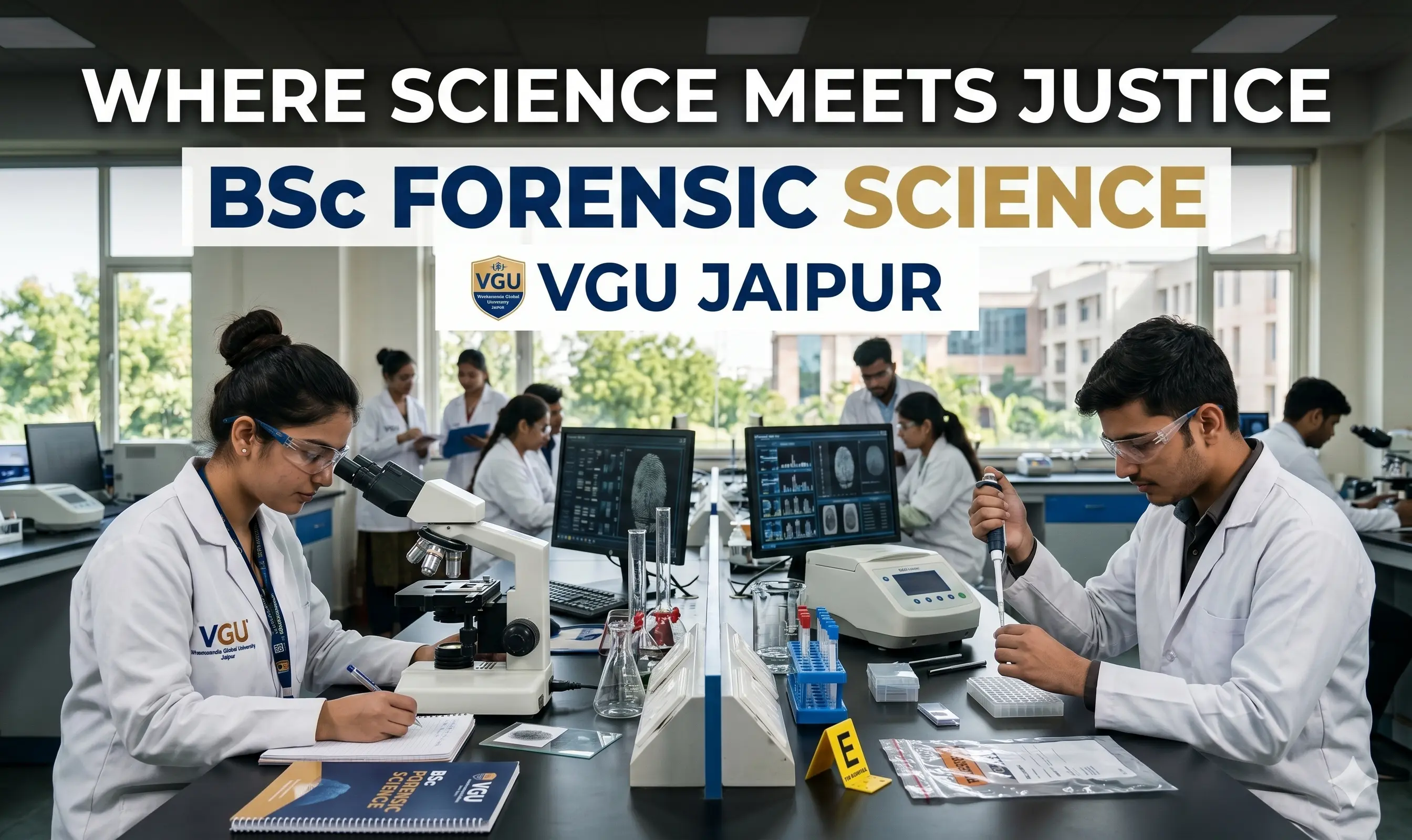
I still remember the first time I walked into the forensic science building at Vivekananda Global University, Jaipur. I was carrying a nervous excitement that only a first-year student can understand — the kind that sits somewhere between wonder and self-doubt. I had chosen BSc Forensic Science not entirely sure of what it meant for my future. CSI episodes had romanticised the idea in my head. What I found at VGU was something far more complex, far more meaningful — and far more transformative — than anything a television show could ever portray.
This is my story. A story of crime scenes I didn't expect to read like books, of DNA that whispered secrets across time, of professors who had lived the very cases we studied, and of a culture at VGU that quietly pushed me from being a passive learner to an active participant in the science of truth.
1. The Day I Learned to Read a Crime Scene
In our second semester, the Department of Forensic Science organised what would become one of the most memorable days of my academic life — a mock crime scene investigation. A room on campus had been meticulously staged: overturned furniture, simulated blood spatter on the walls, an evidence card half-hidden under a chair, and a carefully placed 'victim' outline drawn in chalk. We stood at the door and stared.
We were not handed a script. We were not told where to look. Our faculty simply said: 'Observe. Document. Analyse. Tell us what happened here.'
That was the moment I understood Locard's Exchange Principle in my gut and not just in my notes. Every touch leaves a trace. Every contact transfers material. The criminal always carries something from the scene; the scene always carries something from the criminal. Standing in that simulated room, notebook in hand, I was no longer a student reading about forensic science — I was practicing it.
"Every crime scene is a frozen moment in time. Your job is not to disturb that moment — your job is to listen to it."
VGU's Crime Scene Investigation Laboratory simulates real-world investigative environments. We practised evidence collection, forensic photography, sketching, bloodstain pattern analysis, and chain-of-custody documentation under conditions that replicated actual procedural demands. The department's flagship event, 'Reconstron', required teams to reconstruct pre-staged crime scenes, document findings, and present them as formal scientific reports. It was competitive, intense, and — when we got the details right — deeply satisfying in a way a written exam never quite matches.
The Questioned Documents and Fingerprint Laboratory added another dimension: we were training our eyes to see things that most people walk past every day. The ridge characteristics of a fingerprint, the ink composition variance in a forged document, the hidden indentation on a page that had once carried a critical note — forensic science turned the invisible visible.
2. The National CSI Competition — and What It Took to Compete
The announcement of the National Crime Scene Investigation Competition at VGU — 'CSI 3.0', organised under the Vivek Sherlock Forensic Club — sent the entire department into focused preparation mode. The Vivek Sherlock Forensic Club is our departmental student body dedicated to practical investigation, competitive forensic events, and spreading forensic awareness beyond our department walls.
Teams from across India participated. The competition was not a quiz. It was not a poster presentation. It was a timed, structured investigation of a multi-layered crime scene where teams physically examined, photographed, collected, and analysed simulated evidence — fingerprints, questioned documents, biological stains, trace materials — and constructed a coherent narrative of what had happened, using scientific reasoning alone.
What distinguished VGU's competition from others was its courtroom component. After the scene investigation, teams had to present their findings in a mock court setting — a detail that forced us to think like expert witnesses, not just lab technicians. I had to stand before a panel and defend my findings. My hands shook. My voice steadied. Science does not lie, and when your analysis is correct, conviction follows.
For weeks before the event, we ran drills in the Crime Scene Simulation Lab. We timed ourselves. We peer-reviewed each other's documentation. We debated over the directionality of bloodstains and the significance of fingerprint ridge characteristics. I realised something important: forensic science is not a solitary pursuit — it is a collaborative discipline where the weakest link in the team's observation can determine whether justice is served or denied.
Competing also changed the way I inhabit physical space. I now notice things unconsciously. The angle of a dropped object. The wear pattern on a shoe. The distribution of dust on a tabletop. That is what happens when a discipline truly inhabits your mind.
— — —
3. The DNA Lab — Where Biology Becomes Biography
If the crime scene lab was where I learned to observe, the DNA Analysis Laboratory was where I learned to listen — to biological material that, by all appearances, should be silent.
VGU's Forensic DNA Laboratory offers students hands-on training in DNA extraction, quantification, amplification through PCR, and Short Tandem Repeat (STR) profiling. These are not demonstrations behind glass. We performed the procedures. We pipetted. We loaded gels. We read electropherograms. We made mistakes — and we learned precisely why those mistakes mattered.
What made the DNA lab experience profound was the context in which we learned it. We were not just learning molecular biology techniques in a vacuum. We were learning them with the full awareness of what those techniques represent in the real world. A DNA profile recovered from a crime scene can confirm the presence of a suspect. It can establish parentage. It can identify a victim of a bomb blast. It can exonerate an innocent person who has spent years in prison.
"In forensic science, a single strand of DNA carries more moral weight than the loudest confession. It does not lie. It does not forget. It does not change its story."
The Forensic Biology and Serology Lab complemented the DNA lab with training in the analysis of body fluids — blood identification, semen examination, saliva, hair analysis — using techniques that mirror those employed at the State Forensic Science Laboratory. We also ran environmental degradation protocols, studying how temperature, humidity, and UV exposure affect DNA concentration in blood and saliva stains. A co-authored research paper on exactly this subject, published in the Journal of Forensic Science and Research by our own faculty members including Dr. Mathur, Dr. Daga, and Dr. Umema Ahmed, validated what we were learning in the lab. Seeing the names of my professors on an international peer-reviewed publication made something click — this was not just education. This was science in motion.
4. Copyrights, Patents, and the Culture of Innovation
Here is something I did not expect when I joined a BSc Forensic Science programme: I did not expect to spend time thinking about intellectual property.
VGU is among the few Indian universities where forensic science students are actively encouraged — from early in their academic journey — to think about research output not just as a grade requirement but as a contribution to knowledge. VGU's R&D Cell has registered 380+ patents and copyrights across departments. The Forensic Science department specifically has contributed 22 copyrights and 9 patents through faculty, scholars, and students.
The most galvanising moment for our batch came when Ms. Mrinal Vidani — a senior from our department, BSc Forensic Science Batch 2021–24, continuing into MSc 2024–26 — received the prestigious Rajya Yuva Ratan Award from the Government of Chhattisgarh, with a cash prize of Rs 1 lakh, for her outstanding copyright and innovation achievements. A student — not a professor, not an industry veteran — had done something original enough to be recognised at the state government level.
That single fact changed the quality of my ambition. I stopped thinking of research as an obligation and started thinking of it as an opportunity. My seniors were filing copyrights. They were conducting scientific investigations that led to legally protected original outputs. What was I waiting for?
The department's annual innovation festival, ForQuest, featured an Ideathon, Designathon, and Expo — platforms where students pitched forensic science solutions, designed investigative tools, and connected with industry experts. Being immersed in an environment where innovation was normalised rather than exceptionalized transformed how I approached every assignment, every lab practical, every research question.
— — —
5. Forensic Gyan — When the World Walked Into Our Campus
Five times. For five consecutive years, VGU has hosted the International Conference on 'Recent Developments in Forensic Science' — known on campus simply as Forensic Gyan. Supported by ANRF, drawing 500+ participants including forensic experts, researchers, and global academicians from India and abroad, this conference transformed our campus into a global intersection of forensic knowledge.
As students, we were not spectators. We attended keynote lectures from national and international institutions. We sat in research paper presentation sessions where PhD scholars defended original findings. We attended workshops on DNA profiling, cyber forensics, toxicological analysis, and crime scene reconstruction. We presented our own work — student posters and research showcases — to experts from across the country.
One insight from a veteran forensic scientist at Forensic Gyan 4 reshapes how I write every report to this day: forensic science is an act of translation. You convert scientific findings into a language that a judge, a lawyer, and a jury can understand. A result that cannot be communicated clearly is a result that does not fully exist in the courtroom. That afternoon, I rewrote my entire understanding of what 'good science' means in a forensic context.
Forensic Gyan also gave me something I could not have anticipated: a sense of where the field was going. Sessions on AI in forensics, digital evidence analytics, environmental DNA forensics, and advanced toxicological screening showed me that the discipline I was entering was expanding rapidly. I was not training for a static profession. I was training for a frontier.
6. Mystera — The Festival That Made Forensics Feel Like Home
There is a week every year at VGU when the entire forensic science department transforms into something between a festival and an investigative unit. Mystera — our annual Forensic Science Week Celebration — is that week.
Mystera 3.0, which I participated in, was a multi-day national-level event combining forensic competitions with immersive learning experiences. Segments included forensic runway events, crime scene sketch relay challenges, evidence analysis races, and mock investigative workshops. Teams from other institutions competed against us on our own ground — which meant the energy was both celebratory and seriously competitive.
The Crime Scene Sketch Relay alone taught me precision that no lecture could have conveyed. Teams were given a staged scene and had to recreate it through detailed, accurate sketches — capturing scale, spatial relationships, evidence positions, physical details. If your sketch was imprecise, the downstream analysis was compromised. It was a physical, embodied lesson in why precision matters.
Mystera was also when our department's culture became most visible. Faculty members who maintained the gravity of their subject in lectures laughed alongside us during the events, challenged us in competitions, and pushed us further in workshops. The boundary between mentor and mentee softened — and in its place, a shared devotion to the discipline emerged.
— — —
7. Daga Sir — A Career Told in Case Files
There are professors who teach you subjects. And then there are professors who teach you how to think. Dr. Surya Shekhar Daga — Daga Sir, as we called him — belonged entirely to the second category.
A Professor in the Department of Forensic Science at VGU, Dr. Daga was formerly the Additional Director of the State Forensic Science Laboratory, Rajasthan, with over 35 years of front-line forensic experience. He had analysed more than 2,000 case reports. He was formally recognised as one of the best serologists in Rajasthan. He had received the 'Pioneer of Forensic Science' award. And in his lectures, serology was never just serology.
Every technique he described came embedded in a case. He would stand at the front of the classroom and, almost without effort, tell you about the time a blood grouping result broke open an investigation that had gone cold for years. He would walk you through the logic — not just the protocol — of how he arrived at his conclusions, and how those conclusions were defended in court under cross-examination.
"Evidence doesn't know who it will help or hurt. It only knows the truth. Our job is to be its faithful interpreter."
What struck me most about Daga Sir was his reverence for evidence. Handling biological material from crime scenes — blood, tissue, body fluids — is an act that carries weight beyond its technical demands. He taught us that handling evidence is an ethical act as much as a scientific one. The evidence in your hands may be the only objective voice a victim has. That philosophy, absorbed through his teaching, changed how I approached every single practical session.
8. Mathur Sir — The Man Who Built Rajasthan's DNA Story
If Daga Sir was the conscience of our forensic education, Dr. G. K. Mathur was its ambition. Among students, Mathur Sir occupied a kind of legendary status — not because of rumour, but because of verifiable fact. He had established Rajasthan's DNA Laboratory. He had contributed more than 10,000 serological reports to the justice system. He had served as expert witness in over 200 court testimonies.
And he had been directly involved in cases that every Indian knew. The Salman Khan Black Buck Case. The Bhanwari Devi Case. The Jaipur Bomb Blast Case. The O. P. Nagar CBI Case. The Baby Swapping Case. The Dora Singh Encounter Case. When these were not abstract headlines but the professional biography of the man standing at the front of our lecture hall, forensic science ceased to be theoretical. It became urgently, undeniably real.
Mathur Sir joined VGU after his tenure as Additional Director at the SFSL and teaching at the University of Rajasthan. His transition into academic mentorship was a gift to students like us. He carried not just knowledge but wisdom — the accumulated, tested understanding of what forensic science can and cannot do, where it succeeds, and where it has to be honest about its limitations.
In one lecture, he spoke about the challenges of DNA evidence in cases involving degraded biological material from prolonged outdoor exposure — a topic his own published research had directly addressed. As I sat there, I grasped something about the relationship between research and practice that I had not understood before. In forensic science, knowledge and case experience are not parallel tracks. They are the same road. Research improves what you can do in the lab; the lab produces the questions that drive the research. Mathur Sir was the living proof of that loop.
"In forensic science, your credibility walks into the courtroom before you do. Build it in the lab, every single day."
— — —
9. The FSL Internship — Where Textbooks Become Case Files
No single experience in my BSc journey compressed more learning into a shorter span of time than my internship at the State Forensic Science Laboratory (SFSL), Jaipur.
The SFSL Jaipur is a functioning government forensic laboratory receiving real cases from across Rajasthan — rape, murder, suspected poisoning, bomb blast fragments, narcotics, wildlife crime, questioned documents, cybercrime. Every exhibit entering that building represents a human story waiting for scientific resolution. Its divisions span Biology, DNA, Serology, Chemistry, Toxicology, Ballistics, Questioned Documents, Narcotics, Photography, and Cyber Forensics. Examination reports are admissible under Section 293 of the Criminal Procedure Code as expert testimony in courts of law.
Walking in for the first time as an intern was humbling. Here were scientists — quiet, methodical, precise — who arrived every morning knowing their work that day might determine whether someone went to prison or walked free. There was no drama. There was no soundtrack. There was only the slow, disciplined application of scientific method to exhibits that carried the weight of the events that produced them.
In the Biology and DNA Division, I observed DNA extraction on real biological evidence, watched STR profiling unfold on actual casework, and saw how chain-of-custody documentation was maintained with almost ceremonial rigour. Every movement of every exhibit was logged. Every analyst who touched a sample signed for it. Every result was verified by a second scientist before it entered a report.
In the Serology Division, I observed how blood grouping and body fluid identification were still used as rapid initial screening tools even in the era of DNA — because they are fast, cost-effective, and narrow the investigative field before expensive DNA analysis is commissioned. I understood then why our curriculum was designed the way it was. Daga Sir's serology lectures had not been about historical technique. They were about the present, living practice of forensic science.
I left the internship not just with a certificate but with a recalibrated understanding of what I was training to become — not a scientist in the abstract, but a scientist in service of justice, accountable to real consequences.
10. The Academic Rigour — What VGU's Curriculum Actually Demands
People outside the programme sometimes assume forensic science is lighter than a traditional BSc in Chemistry or Life Sciences. Those people have not spent a semester simultaneously mastering forensic toxicology, questioned document examination, ballistics, DNA profiling, cyber forensics, and criminal law.
VGU's curriculum, aligned with NEP 2020, is deliberately multidisciplinary. In a single academic year, I studied subjects spanning biology, chemistry, physics, psychology, law, and digital technology. The assumption underlying this design is sound: real crime scene evidence does not respect disciplinary boundaries. A crime scene may yield biological evidence, chemical trace evidence, digital evidence, and document evidence simultaneously. The forensic scientist who investigates it must be conversant with all of these domains — not merely familiar.
The practical load matched the theoretical one. We did not just read about fingerprint ridge characteristics — we lifted, developed, and classified fingerprints from varied surfaces under varied conditions. We did not just study toxicological screening — we ran chromatographic analyses on simulated samples. We did not just learn about digital forensics — we recovered data from devices and analysed digital evidence trails in the Cyber Forensics Laboratory.
What made the rigour sustainable — and even energising — was that every subject was anchored to its human significance. In forensic science, the answer to 'why does this matter?' is never abstract. It matters because somewhere, a victim's family is waiting. It matters because the integrity of the justice system depends on the accuracy of the science that feeds it. Faculty at VGU did not let us forget this. The academic rigour was not about producing students who could pass examinations. It was about producing scientists who could be trusted when it counted most.
— — —
11. How It Changed the Way I See the World
Three years into this programme, I notice changes in myself that are harder to articulate than any laboratory finding.
I read crime news differently. Where I once read headlines, I now read the forensic subtext — what kind of evidence might have been present, how it would have been collected, what the likely analytical pathway would be, what would be required to make that evidence stand in court. I find myself thinking about documentation before drama.
I think about causation more carefully. Forensic science trains you to distinguish between correlation and causation with near-obsessive precision, because in a criminal investigation, the wrong inference can ruin a life. That precision migrates. You start applying it to arguments you hear, to data you encounter, to claims people make in everyday conversation. It is both a professional skill and, quietly, a life skill.
I have a deeper respect for patience. Forensic science does not reward haste. A result that arrives quickly but is contaminated is worse than no result at all. The discipline trains you to wait, to verify, to repeat — and to derive your confidence not from speed but from methodological integrity.
And I have a sense of purpose that I did not have when I first walked through VGU's gates. I came in curious. I stayed for the knowledge. I will leave carrying a responsibility — to the science, to the profession, and to every person whose case will one day depend on work like mine.
A Note to Every Aspiring Forensic Scientist
If you are genuinely considering forensic science, let me tell you what the television shows will never tell you. The work is slow. The stakes are real. The margin for error is essentially zero. And because of all of that, it is among the most meaningful things a scientist can choose to do.
VGU gave me crime scenes that spoke, DNA that told stories, professors who had lived the chapters we were studying, a conference stage where student ideas were taken seriously, an FSL where real justice was in motion, and a community of peers who were as serious about the work as I was trying to become.
Every trace tells a story. My three years here told mine. And the case is still very much open.
1. Why is VGU Jaipur considered a good university for BSc Forensic Science?
Vivekananda Global University is considered a strong choice for BSc Forensic Science because of its advanced forensic laboratories, crime scene simulation training, DNA analysis facilities, FSL internships, experienced faculty, and practical learning environment aligned with real-world forensic investigation.
2. Does VGU Jaipur provide practical crime scene investigation training?
Yes, VGU Jaipur provides hands-on crime scene investigation training through mock crime scene simulations, forensic photography exercises, evidence collection practices, fingerprint analysis, bloodstain pattern analysis, and courtroom presentation activities that replicate real forensic procedures.
3. What forensic laboratories are available at VGU Jaipur?
VGU Jaipur offers specialised forensic laboratories including Crime Scene Investigation Labs, DNA Analysis Labs, Cyber Forensics Labs, Fingerprint & Questioned Document Labs, Toxicology Labs, and Forensic Biology & Serology Labs for practical student training.
4. Does VGU Jaipur provide FSL internships for forensic science students?
Yes, forensic science students at VGU Jaipur get opportunities for internships at State Forensic Science Laboratories (SFSL), where they gain exposure to real forensic casework, DNA profiling, toxicology analysis, cyber forensics, and evidence examination.
5. Who teaches forensic science students at VGU Jaipur?
VGU Jaipur has experienced forensic science faculty including experts who have worked in government forensic laboratories and handled real criminal investigations. Students learn directly from professionals with expertise in DNA analysis, serology, toxicology, and courtroom forensic practices.
6. What career opportunities are available after BSc Forensic Science from VGU Jaipur?
Students can pursue careers in forensic laboratories, crime investigation agencies, cyber forensic units, research organisations, law enforcement departments, private investigation firms, and higher education or research in forensic science specialisations.
7. Does VGU Jaipur organise forensic science events and competitions?
Yes, VGU Jaipur regularly organises forensic science events such as crime scene investigation competitions, forensic innovation festivals, workshops, forensic conferences, and student research expos that help students build practical and analytical skills.
8. Is forensic science at VGU Jaipur focused on practical learning?
Absolutely. The forensic science program at VGU Jaipur combines theoretical knowledge with intensive laboratory practice, field exposure, research opportunities, internships, and case-based learning to prepare students for real forensic investigations and courtroom procedures.


