
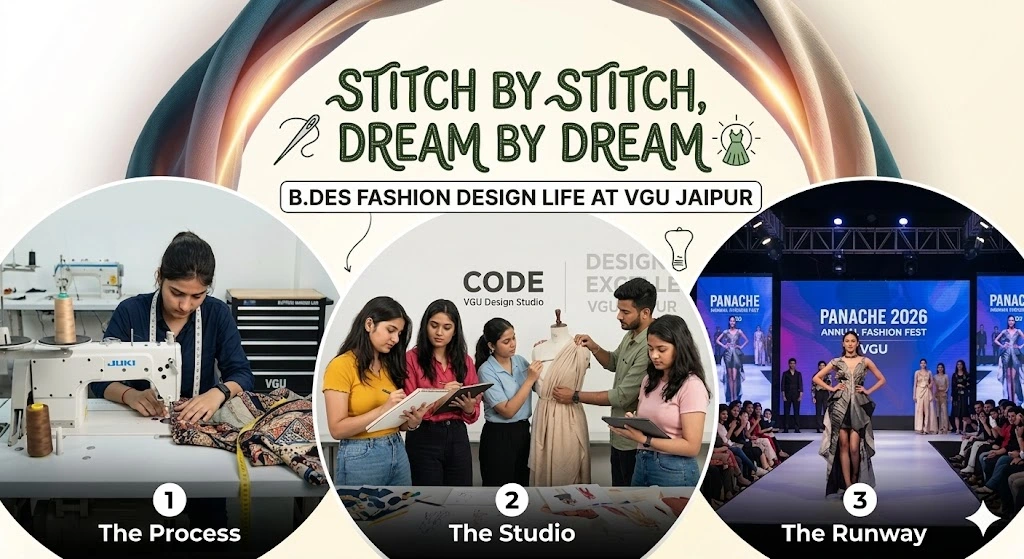
1. The Call of the Runway
There is a specific kind of silence that descends on you the moment the music starts and the first model steps onto the runway. Everything you worked on for months — the sleepless nights, the sore fingers, the arguments over a seam — dissolves into a single, glittering instant. I remember standing backstage at our Turpan show at Diggi Palace, Jaipur, heart hammering, palms clammy, watching the spotlights carve golden corridors through the darkness. I was a Bachelor of Design student at the Faculty of Design, Vivekananda Global University — and this was the moment every sketch, every fabric swatch, and every pin had been building toward.
Turpan — the annual flagship fashion show of VGU — is not just a college event. It is a rite of passage. Held at iconic venues across the Pink City, from the grandeur of Diggi Palace to the modern spectacle of World Trade Park (WTP), Turpan is the one night a year when the entire city of Jaipur watches young designers transform raw creativity into living, breathing fashion. The show has featured over 100 models and designers in a single evening, making it one of the most ambitious student-led fashion spectacles in Rajasthan. And I was right in the middle of it — not as a spectator, but as a designer who had built every garment on the rack backstage with my own two hands.
❝ Every stitch I made was a sentence in a story I had been writing since the day I walked into Faculty of Design, VGU. ❞
— ✦ —
2. The Venue: Where History Met Haute Couture
Diggi Palace is not just a venue — it is a mood. Set in the heart of Jaipur, this heritage property with its wide courtyards, lantern-lit corridors, and regal arches transforms every fashion show into something cinematic. When VGU chose Diggi Palace as the stage for Turpan, I understood immediately that we were not putting on a college fashion show. We were making a statement. The general public mingled with jury members, fashion critics, industry guests, and nervous families in those lawns. The energy was electric — a beautiful chaos of photographers jostling for angles, guests in their finest, and models doing last-minute touch-ups in the dressing rooms.
In later editions, we also took the show to World Trade Park — Jaipur's premier lifestyle and retail destination — and the contrast was breathtaking. The WTP show was sleek, modern, and unapologetically contemporary, with mall-goers stopping mid-stride to watch our collections walk past glass-panelled corridors. Seeing strangers — who had come to buy groceries or catch a movie — suddenly stop, pull out their phones, and film our designs was one of the most surreal and validating moments of my entire design education. It reminded me that fashion is not confined to galleries or galleries. It lives on streets, in malls, in the eyes of anyone who pauses to look.
❝ At WTP, a little girl tugged her mother's sleeve and pointed at my piece on the model. That was worth every late night. ❞
— ✦ —
3. The Research: Where Every Collection Begins
Nobody tells you how much of fashion design is actually sitting in a corner with a mood board, a sketchbook, and a rapidly cooling cup of chai. Before a single fabric was touched, before any pattern was drawn, I spent weeks in research mode — conducting user surveys, visiting Jaipur's vibrant textile markets in Johari Bazaar and Bapu Bazaar, and exploring the rich craft traditions of Rajasthan. My research process involved studying colour theory, cultural motifs, contemporary runway trends, and even psychological responses to colour and silhouette. I built questionnaires, ran informal interviews with potential users, and gathered feedback on everything from neckline preferences to acceptable hem lengths.
This was user-experience thinking applied to fashion — and it was something VGU drilled into us from the very beginning. Design, our faculty always reminded us, is never about what the designer likes. It is about what the wearer needs, feels, and becomes. So I designed not just garments but experiences — wearable narratives crafted from data, emotion, and a deep study of my intended audience. I found myself drawn to rich earthy tones contrasted with unexpected pops of colour: burnt ochre meeting electric teal, dusty rose sitting beside charcoal. These weren't arbitrary choices — they emerged from weeks of research into colour psychology and field observation.
Textile Selection: The Heart of the Collection
The fabric selection process is where I truly fell in love with fashion. Walking into the textile labs at Faculty of Design VGU — walls lined with fabric swatches in every texture imaginable — felt like entering a library written in cloth. I experimented with georgette, chanderi, raw silk, khadi, and sustainable blended fabrics. I held each against the light, studying how it draped, how it breathed, how it moved. Some fabrics were discarded after a single test drape. Others revealed themselves slowly, showing their magic only once you put them on a moving body.
For my Turpan collection, I ultimately chose a combination of handwoven khadi for structure and a flowy chiffon-blend for movement — a deliberate conversation between India's heritage textile tradition and contemporary silhouette. The colour palette was meticulously tested in natural and artificial light, because what glows under the studio fluorescents can look entirely different under runway spotlights. I learned this the hard way in my first semester, when a piece I thought was a soft blush turned into a washed-out pale on stage. I never made that mistake again.
— ✦ —
4. The Labs: Where Magic Became Real
The Pattern Making Lab
If the runway is the stage, the Pattern Making Lab at VGU is the rehearsal room — and it is the place I spent more hours than I can count. Pattern making is both science and art: translating a two-dimensional sketch into a three-dimensional wearable form requires mathematical precision, spatial intelligence, and an almost intuitive understanding of the human body. I remember my early attempts — the pattern pieces that were technically correct but somehow produced garments that looked nothing like what I had imagined. It was humbling.
But slowly, session by session, guided by our faculty and the legendary Masterji — the tailoring master at Faculty of Design whose hands seemed to speak the language of fabric — I learned to read the grain line, to account for ease, to draft a bodice that would sit perfectly on a real body. Masterji had decades of craft knowledge in his fingertips. He would look at a pattern piece for two seconds and immediately say: 'Yahan se thoda lena padega' — 'You'll need to take a little from here.' And he was always right. His mentorship was not formal. It happened in those quiet moments between cuts, between measurements, in the language of doing.
The Tie & Dye Lab
One of the most unexpectedly joyful spaces in VGU's design ecosystem is the Tie & Dye Lab. Walking in meant surrendering to colour — vats of vibrant dye in indigo, turmeric yellow, pomegranate red, and earthy browns lined the worktables. The process of tying, binding, and submerging fabric into dye is meditative and wildly unpredictable at the same time. No two pieces come out exactly the same, which means every garment you create in that lab is, by definition, one of a kind.
I used tie-dye techniques not just as surface decoration but as a central design element in one of my collections — using the pattern of the dye to mimic organic, natural forms. The resist-dyeing process, where tied sections resist colour penetration, created intricate negative-space designs that I could not have achieved with any other technique. The lab taught me to embrace the unpredictable — a lesson that extends far beyond textiles.
The Stitching Lab & Long Studios
The stitching lab was where hours dissolved into nothing. With the hum of machines as a constant soundtrack and fabric moving under needle and thread, the stitching lab had its own kind of silence — the silence of deep focus. We worked on industrial sewing machines, learned hand-stitch techniques for finishing, and discovered the radical difference between a seam that is merely functional and one that is beautifully crafted. I spent entire evenings in the long studios — those vast, open workspaces at Design department where teams spread out their work across enormous tables, pinning, cutting, pressing, and assembling.
The long studios had an atmosphere that I can only describe as collective creative energy. At 11 PM, when most of the campus was winding down, the studios were still blazing with light and alive with the sound of scissors and urgent conversation. Seniors helped juniors. Batch-mates traded techniques. Someone would put on music — always the right music for the mood of the collection being made — and the entire room would fall into a rhythm. These were the nights that built not just collections but bonds.
— ✦ —
5. Late Nights, Faculty Mentorship & the Masterji Magic
The week before Turpan, time ceased to function normally. Days and nights blurred into a continuous stream of fittings, alterations, accessory trials, and anxious consultations. I would wake up thinking about a dart that wasn't sitting right. I would fall asleep with a sketchbook on my face. The faculty at VGU — particularly in the Fashion & Textile department — were extraordinary in these crucial days. They didn't just guide us technically. They held us emotionally. Dr. Shweta Choudhary, Dean of the Faculty of Design, had built a department culture where no student's creative struggle went unnoticed.
Faculty members would walk the studios late into the night, offering not just technical corrections but creative encouragement. A senior professor once sat with me for two hours at midnight, not to fix a seam but to help me find the story I was trying to tell with the collection. 'Every garment should have a reason to exist,' she said. 'What is yours telling us?' That question changed the way I designed — forever. And then there was Masterji, the quiet anchor of our practical education. He was the bridge between our sketched dreams and their material reality. Without him, half our collections would never have made it off the cutting table and onto the runway.
❝ Masterji would look at a piece of fabric and know — before the first cut — exactly what it wanted to become. ❞
— ✦ —
6. Background Cloth, Accessories & Building Everything From Scratch
One aspect of our Turpan preparation that no one outside fashion education quite appreciates is the selection of backdrop and background cloth for presentations, lookbook shoots, and stage staging. Every texture that the camera or eye catches behind the garment either elevates it or kills it. We spent afternoons sourcing background fabrics — antique-finish jute, raw linen, draped muslin — testing how each interacted with our collection's colour palette and silhouette. The backdrop is never just a background. It is part of the visual composition.
But the element that consumed the most creative energy — and gave me the most personal joy — was accessories. I built every accessory in my collection from scratch. Statement neck pieces assembled from recycled materials, hand-wrapped bangles using copper wire and resin drops, embellished belts constructed from fabric remnants and upcycled hardware. There is a fierce pride in wearing something to a fashion show and being able to say: 'I made this. All of it. With my hands.' The accessories department at CODE VGU encouraged radical material experimentation — we were told that the boundary between fashion and art is something we should dissolve, not respect.
I used everything — paper, wire, wood beads, broken mirror fragments, terracotta clay, and even dried botanicals — to create accessories that told the same story as my garments. The material selection was always tied to the research: if my collection was rooted in the organic patterns of Rajasthani block printing, my accessories echoed that language in three dimensions. Nothing was random. Everything was intentional. Building from scratch gave me something no purchased accessory ever could — absolute alignment between the garment and its complement.
— ✦ —
7. Model Selection, the Showstopper & the Rush of the Runway
Model selection for Turpan was an experience in itself. We held auditions — actual casting calls — where students from across the campus walked for us, and we had to make decisions about who best embodied the energy of each collection. It wasn't just about height or conventionally accepted proportions. It was about how a person carried themselves, how they moved with purpose, how they connected with the garment. Some of the most memorable looks at our Turpan editions were worn by students who had never modelled before — but who had an undeniable presence that the camera loved.
And then there was the showstopper. The showstopper is the anchor of any fashion show — the grand finale look that the entire show builds toward. Selecting the showstopper model was a high-stakes creative decision. The look had to be the boldest, the most technically accomplished, and the most emotionally resonant piece in the collection. For our show, Turpan 2022 featured Bollywood actress Mugdha Godse as one of the celebrity showstoppers — a moment that electrified the entire event. But for those of us backstage, the real showstopper was the moment our classmates walked that runway with our creations draped around them, and the audience broke into applause.
The energy backstage in the final thirty minutes before showtime is something I will carry with me for the rest of my life. Hair and makeup artists working in controlled frenzy. Designers making last-second alterations with trembling hands. Models stretching, practising their walks, checking their accessories. The choreographer running through the order. And then — the music drops, the lights dim, and one by one, your creations walk out into the world. You breathe only when the showstopper returns backstage and everyone erupts.
❝ The moment the showstopper walked, time stopped. That second of stunned silence before the applause — that is why we do this. ❞
— ✦ —
8. The FDCI Internship: Where the Real World Opened Up
Among the many defining experiences of my B.Des journey, the internship with the Fashion Design Council of India (FDCI) stands apart as a category of its own. The FDCI is the apex body of Indian fashion — the organisation that manages Lakmé Fashion Week, India Couture Week, and supports over 400 member designers, including the names that define Indian fashion globally. Walking into that ecosystem as an intern from faculty of design VGU was equal parts exhilarating and humbling. CODE VGU students have been spotted at marquee events including at Lakmé Fashion Week, putting their fashion and design skills to the test on the biggest runway stages in India.
The internship immersed me in the real mechanics of fashion — not the romantic version, but the operational reality. I assisted in the backstage coordination of events, worked on mood boards for upcoming collections, helped with fabric sourcing documentation, and observed design review sessions with established designers. Exposure to top designers, a fast-paced and exciting work environment, great networking, and hands-on experience with real projects — that is how FDCI internship alumni describe it, and every word of that description rang true in my experience.
What the FDCI internship gave me most powerfully was a sense of scale. The scale of what is possible when fashion is done at its highest level. The precision of scheduling, the hierarchy of creative decision-making, the sheer logistical complexity of producing a couture week — all of it recalibrated my understanding of what the industry actually demands. I came back to CODE VGU with a completely different standard of excellence in my head.
— ✦ —
9. Jury, Masterclasses & Learning From the Masters
One of the most intellectually stimulating dimensions of the faculty of design VGU experience is the jury system. Our collections were not simply admired — they were critically evaluated by panels that included working fashion designers, industry professionals, and seasoned academics. Standing in front of a jury with your work hanging before you, answering questions about every creative decision you made, is a deeply clarifying experience. There is nowhere to hide. The jury doesn't care about how late you stayed up or how many times you started over. They respond to the work.
And the masterclasses were revelatory. CODE VGU regularly brought in practising fashion designers — names from India's active design landscape — to lead intensive sessions. These were not lectures. They were conversations. Designers shared the unfiltered reality of running a label: the supplier who disappears three days before a collection needs to ship, the model who backs out on show day, the collection that gets universally misunderstood by buyers. They also shared the transcendent moments — when a design breaks through, when a garment takes on a life of its own. The EnCODE design festival, which was held in conjunction with Turpan, brought industry experts into direct interaction with students through workshops, exhibitions, and interactive sessions.
— ✦ —
10. The Teams: Designing Is Never Truly Solo
Fashion education romanticises the solitary genius. The reality at CODE VGU was far more interesting: it was collaborative. Our batch was divided into teams for various stages of production, and watching how different creative personalities intersected — and occasionally collided — was its own masterclass in the dynamics of the creative industry. There was the ultra-precise student whose patterns were architectural in their accuracy. The intuitive draper who worked without patterns entirely. The colour savant who could look at a swatch and immediately name its pantone reference. And the researcher who built the most exhaustive mood boards any of us had ever seen.
Working across these teams — borrowing techniques, offering feedback, absorbing approaches entirely different from my own — made me a far more complete designer than I could have been working in isolation. In the build-up to Turpan, the team energy was extraordinary. Disagreements were real and sometimes heated, but they were always in service of the work. Every argument about a colour choice or a silhouette decision was, at its root, a conversation about what we collectively believed fashion could and should do.
— ✦ —
11. Watching Seniors Launch Brands — The Motivation That Never Slept
Among the most powerful motivators of my entire B.Des journey at faculty of design, VGU was watching seniors — those who had walked the same studios, worked the same pattern-making tables, and stood at the same Turpan backstage — go on to launch their own fashion brands. Be Bosy, a homegrown brand specialising in women's western and formal wear, was born from exactly this environment — founded by a VGU design graduate with a passion for fashion and textiles ignited during her studies. Kavedia is another name that circulated in the corridors of design department, VGU — a reminder that the labels we see at markets and on Instagram feeds have their origin stories in rooms exactly like the ones we were working in.
These brands were not distant aspirations. They were visible, tangible proof. Seniors would return to campus — sometimes to the very studios where they had learned — and talk about the process of building something from nothing. The sourcing trips. The Instagram strategy built from scratch. The first order that took three months to arrive and another three months to sell. The moment a stranger — not a friend, not a family member — bought something you made and loved it. Hearing these stories in the same spaces where I was still learning to sew a French seam was one of the most powerful things CODE VGU's culture offered.
❝ Every senior brand I saw launch was a letter from the future — proof that what we were building in these labs was real. ❞
— ✦ —
12. The Glamour, the Energy & the Designer I Was Becoming
Turpan taught me something that no classroom can teach: what it feels like to be a designer. Not to study design. To be one. The glamour of the show — the spotlights, the music, the dressed-up audience, the celebrity showstoppers, the social media coverage — is real and it is exhilarating. But what lives underneath the glamour is even more real. It is the knowledge that you built something. That the garment on the runway is there because of decisions you made, skills you developed, problems you solved, and a vision you refused to abandon even when it felt impossible.
At faculty of design VGU, I found my design voice — slowly, haltingly, then with increasing confidence. The department, ranked AIR 25 for Design in the Outlook Rankings, gave me the infrastructure: the labs, the faculty, the Masterji, the studios. But the other ingredient — the willingness to stay up all night because you believe in what you're making — that came from inside. And it was fed by the culture of CODE VGU, where ambition is treated not as vanity but as the natural condition of a creative mind.
Jaipur, I should add, is a city that conspires with your fashion education. Its bazaars, its block printing workshops, its architectural geometry, its layered textile heritage — all of it seeps into your work whether you intend it to or not. Studying fashion design here is to be permanently enrolled in the city itself as a second school. That is a gift you don't fully appreciate until you're far from it.
— ✦ —
13. What Turpan Left in Me
If I try to explain what faculty of design VGU and Turpan did for me in a single sentence, I would say: they made me believe that I am a designer. Not someone learning to design. An actual designer — with a point of view, a process, and a hunger to keep creating. That belief is the most valuable thing any education can give you, and it is not easily earned.
I think of the Diggi Palace courtyard on show night — the lanterns, the music, the audience leaning forward. I think of the WTP runway, with a crowd of strangers suddenly stopping to watch. I think of the Pattern Making Lab at midnight, and Masterji's hands moving with their unhurried certainty. I think of the Tie & Dye Lab smelling of vinegar and colour. I think of the long studios, and the collective hum of a batch building something together. I think of the FDCI internship, and what it felt like to see fashion at scale.
And I think of that first time a model walked in something I made — something I built stitch by stitch, decision by decision, with no guarantee that it would work — and the audience applauded. In that moment, I understood why designers do this. Not for the applause. But for the proof — the undeniable, visible, walking, breathing proof — that what lives in your imagination can be brought into the world.
❝ To every student standing at the edge of their first studio night, wondering if they have what it takes: stay. It takes everything you have. And it gives back more. ❞


